

Rise of the Videobook
- Thomas Corfield

- 2 days ago
- 3 min read
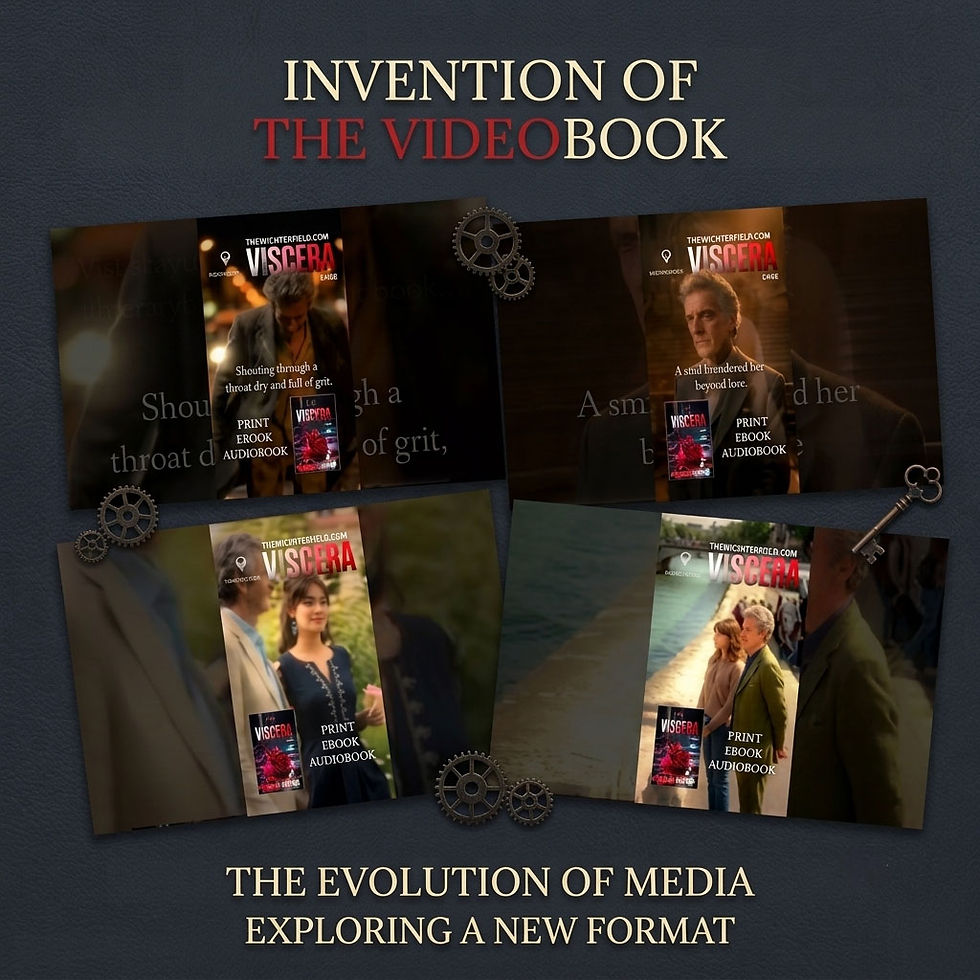
When writing the first three Doooven books, I began experimenting with what I called polyauthorism: the creation of supplementary media designed to support and expand a book's story world. At the time, this primarily meant producing videos that combined narrative excerpts with still imagery that represented scenes I saw in my mind's eye.
What began as a simple exercise in visual accompaniment gradually evolved into something more ambitious. The imagery became more sophisticated, artwork was developed directly from the books and the relationship between text and visual media became increasingly intertwined. By the time I reached the Morigan Tetralogy, the concept had matured into what I would eventually call the videobook.
A videobook is not simply an audiobook with pictures attached. Rather, it is an attempt at translating reading experience into a visual medium. It combines narration, music, imagery and atmosphere to create short, one-minute cinematic interpretations of a novel's world while remaining rooted in the text itself.
The recent release of the Viscera pushed this concept even further. The videobook evolved from a companion piece produced after publication into an integral part of the book's presentation. Short videobook excerpts were released through social media that faciliated a nuanced yet sophisticated visual gateway into the story that allows readers to encounter characters, locations and themes before opening the book itself.
What interests me most, however, is not the marketing potential of this format but what it contributes to the creative process. As writers, we experience stories first through the mind's eye. Characters emerge, settings take shape and scenes unfold in an internal space that is rich in emotional detail but often indistinct visually. The videobook provides a bridge between those internal impressions and a tangible visual representation.
While writing, I increasingly create visual references for characters and locations alongside the manuscript. Supported by my proprietary Novelis binder software, this process allows develop consistent character imagery and scene compositions that can then be readily developed into videobook production. Combined with carefully selected music, these visual references create a richer sensory experience of the story as it unfolds. This represents the next stage in the evolution of the videobook: rather than being produced after a novel is completed, the videobook can develop alongside the unfolding manuscript. The story and its visual interpretation evolve together, with each informing the other across the writing process.
For my next novel, the dark humor political eco-thriller Wasted, this is precisely the approach I intend to take. Videobook excerpts will be created and released as the novel is being written. in this way, the videobook becomes more than promotional tool or supplementary product, and instead part of my creative journey.
Perhaps the strongest evidence for the power of this format came at the conclusion of the Viscera videobook productions. More than any other book, I felt a deep, serrated sense of loss when leaving it behind, the atmosphere, characters and emotional weight of the story having become deeply embedded through the videobook's process of visualising, editing and experiencing its world beyond the page. It rendered my experience of the story dangerously serrated and intensely bright: a visual clarity that reinforces the softer, more elusive emotional detail of the mind's eye. Together, they create an umbilical tethering between author and story that, when inevitably severed, is genuinely painful.
This suggests that the videobook does more than enhance reader engagement. What began as an experiment in supplementary media has evolved into a new way of both experiencing and writing fiction, one that sits somewhere between the written word and cinema, and one that will break my heart again when I leave Wasted behind for the third wrong book.


